

Reassurance – UK Company, UK Support
November 13, 2026Article | Understand – When Doesn’t GPS Work?
Written by: Chris Knowles, Technical Director
When Doesn’t GPS Work?
“It’s chucking it down. That’s why the tracker’s lost me.”
It isn’t. Garmin says GPS “works in any weather conditions”, and the signal will “pass through clouds, glass and plastic”. Rain isn’t what stops a tracker. A roof is, every day.
So here is one week on the round: one call a day from the planner, and one night it might really have been the sky.
Monday, 06:10: The Loading Bay
“Where are you? You’ve dropped off the map.”
You are where you have been since half five: under the steel canopy at the loading bay, waiting for someone inside to find the shutter button.
Each GPS satellite is about 20,000 km up, and Garmin gives its transmitter power as “only 50 watts or less”: less than the old 60-watt bulb nobody has changed in the drivers’ toilet, shining from 20,000 km away. It arrives “incredibly weak” and travels “by line of sight”, so it needs a straight run from the satellite to the box. Glass and plastic, fine. Steel, no chance. The box needs at least four satellites at once to find itself, and under a canopy it gets next to none.
The van hasn’t dropped off the map. It has a lid on.
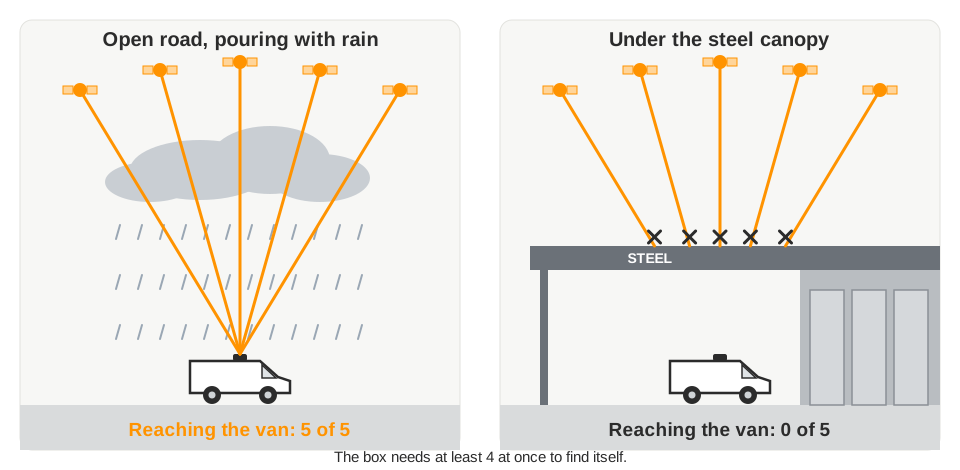
Rain lets every signal through to the van; a steel canopy stops every one of them.
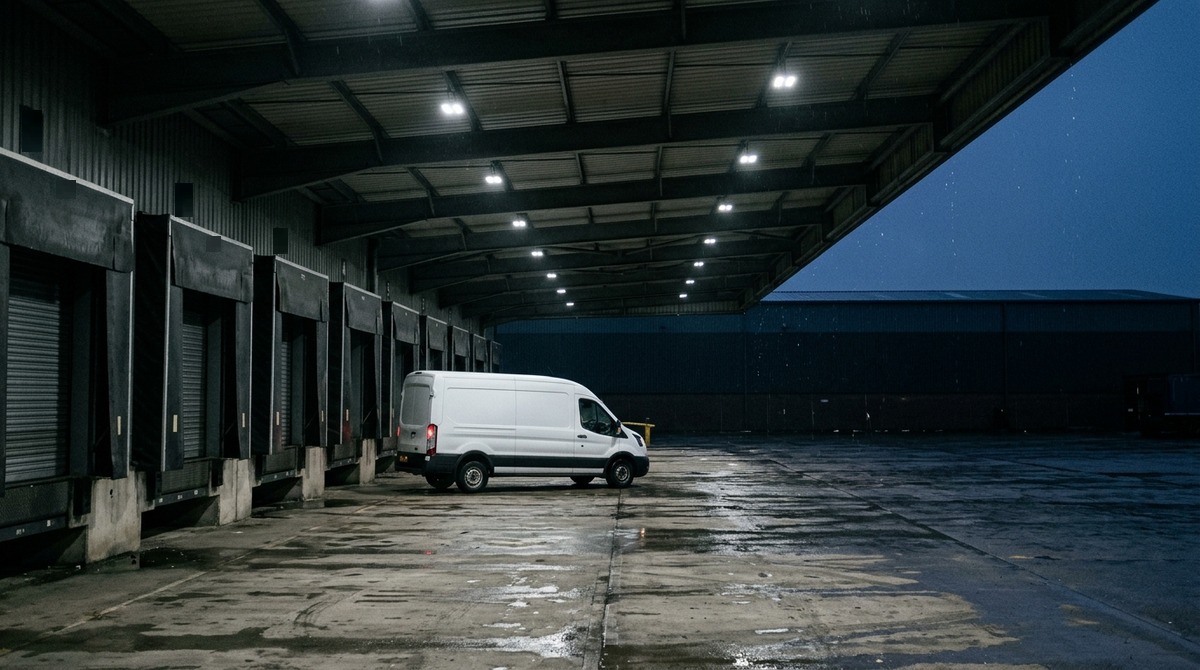
Tuesday: The Bottom Deck
“You’ve vanished again. Forty minutes this time.”
Bottom deck of a multi-storey, then the basement goods-in under some new flats. GPS.gov lists the “common causes” of bad GPS, and two of them are your Tuesday: blockage by “buildings, bridges, trees, etc.” and “indoor or underground use”. Flyovers and tunnels count too.
Five floors of car park on top of the van, and the planner wants to know why the satellites can’t see it. Nothing went missing. Nothing could get in.
Wednesday: The Tall Street
“It had you fine in this street a fortnight back. Same time.”
It did. Between tall buildings the box only sees a strip of sky straight up; satellites low down are behind the buildings.
Each GPS satellite goes round the Earth in about 11 hours and 58 minutes (Wikipedia), so the same ones come back to the same bit of sky about four minutes earlier each day. Four minutes a day is nearly an hour a fortnight. Same street, same clock, different satellites over the gap, and some weeks there aren’t four. The only thing on the round that turns up early every single day, and it still won’t come down a narrow street.
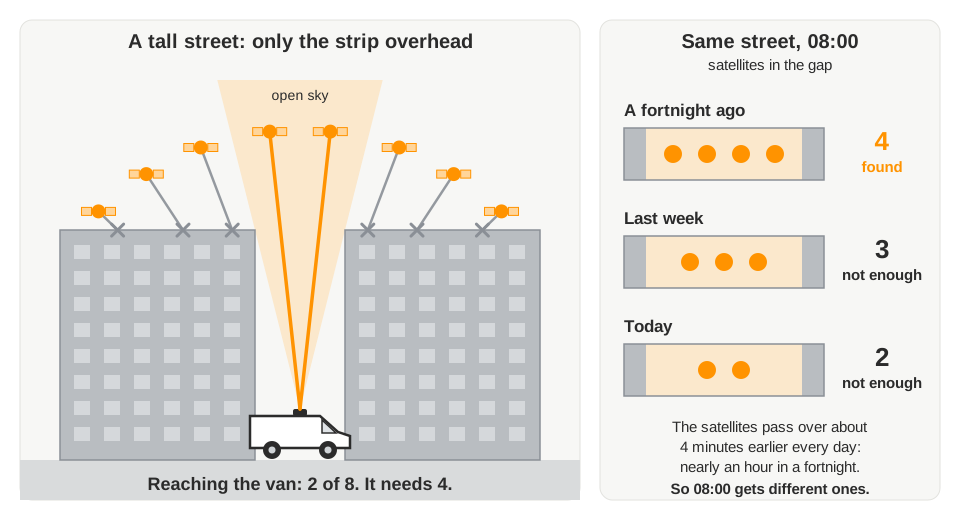
Same street, same clock time: the satellites in the gap change week by week, and today there aren’t four.
Thursday: The Hire Van
“Now you’re saying the sat-nav’s lost you too? It’s on the windscreen. It can see straight out.”
Plain glass lets GPS through. Some windscreens aren’t plain glass. Hema, who make sat-navs, has come across screens with fine tungsten heating elements that can “act as a type of shield for the GPS signals”. A Pilkington patent says a screen with a conductive coating would block a GPS device enough that it “would not function in a vehicle fitted with the windshield”. So the design leaves a patch where the coating “is absent from a pattern of dots”.
A window in the window. On a coated screen like that, a sat-nav stuck anywhere else might as well be back under the canopy.
Friday: The Van That’s Been Sat
“It’s not showing at all. Have you even left?”
No. It is 05:40, you are back from a fortnight off, and the van battery went flat while you were away. Jump leads on, and the box has lost its clock and where it was. A box that still knows the time and where it is starts warm, in about 45 seconds. One that has lost both starts cold: typically 2 to 4 minutes, says Wikipedia. It starts collecting the almanac, the rough timetable of every satellite, which takes 12.5 minutes to send in full; a modern box finds itself well before the end, and older kit might wait the lot. TomTom tells its own customers to “wait up to 5 minutes for the GPS fix”.
Two minutes stood still is not a fault. It is the box reading the timetable, and the planner can wait for it like everyone else.
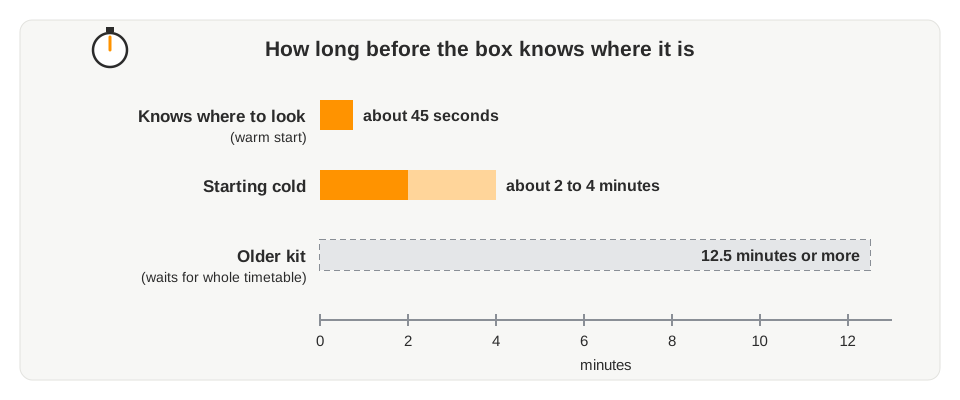
Warm, under a minute; cold, typically 2 to 4 minutes; older kit may wait for the whole timetable.
6. Saturday Night: When It Really Is the Sky
On Saturday 10 October a “strong G3 geomagnetic storm” put the Northern Lights over the UK, Nature World News reported. NOAA’s storm scale says a G3 can bring “intermittent” satellite navigation problems, and at the top of the scale it “may be degraded for days”. No report ties that night to a tracker failing.
And nobody rang. The one night the sky might have been to blame, the planner was out the back with their phone pointed at it like everybody else.
7. Why This Matters for Your Business
At Pay as you Track, we do things differently. Our own site says it: “If the satellites are not contactable, then the location can’t be fixed”. So we plan for it.
- Battery trackers have a backup: our battery trackers fall back to GSM backup from local cell towers. We say plainly it is “not as accurate as GPS”, and the MAP and REPORTS tabs show whether each position was GPS or GSM.
- Fitting is checked: our hardwired trackers go in with a qualified auto electrician, and the Engineer app in our software checks “Wired Correctly? GPS Lock?” after fitting.
- Jamming is a different story: someone blocking the signal on purpose is not a roof, and on our hardwired trackers you can set up a jamming alert for it.
- A gap is a building: forty minutes of nothing at a loading bay is a fact about the canopy, not the driver.
See our trackers and add-ons and our YouTube channel.
Back to the Loading Bay
Monday again. 06:10, same canopy, shutter still down. The phone goes. This time the planner doesn’t ask where you are. They ask what’s over you. That is our job at Pay as you Track: knowing which question to ask.
So the next time the dot stops for forty minutes, wouldn’t you rather look at the roof than ring the driver?
Talk to Pay as You Track today on 0161 914 5500 or email [email protected] to see how we can help your business.
Or alternatively, chat with us on WhatsApp